

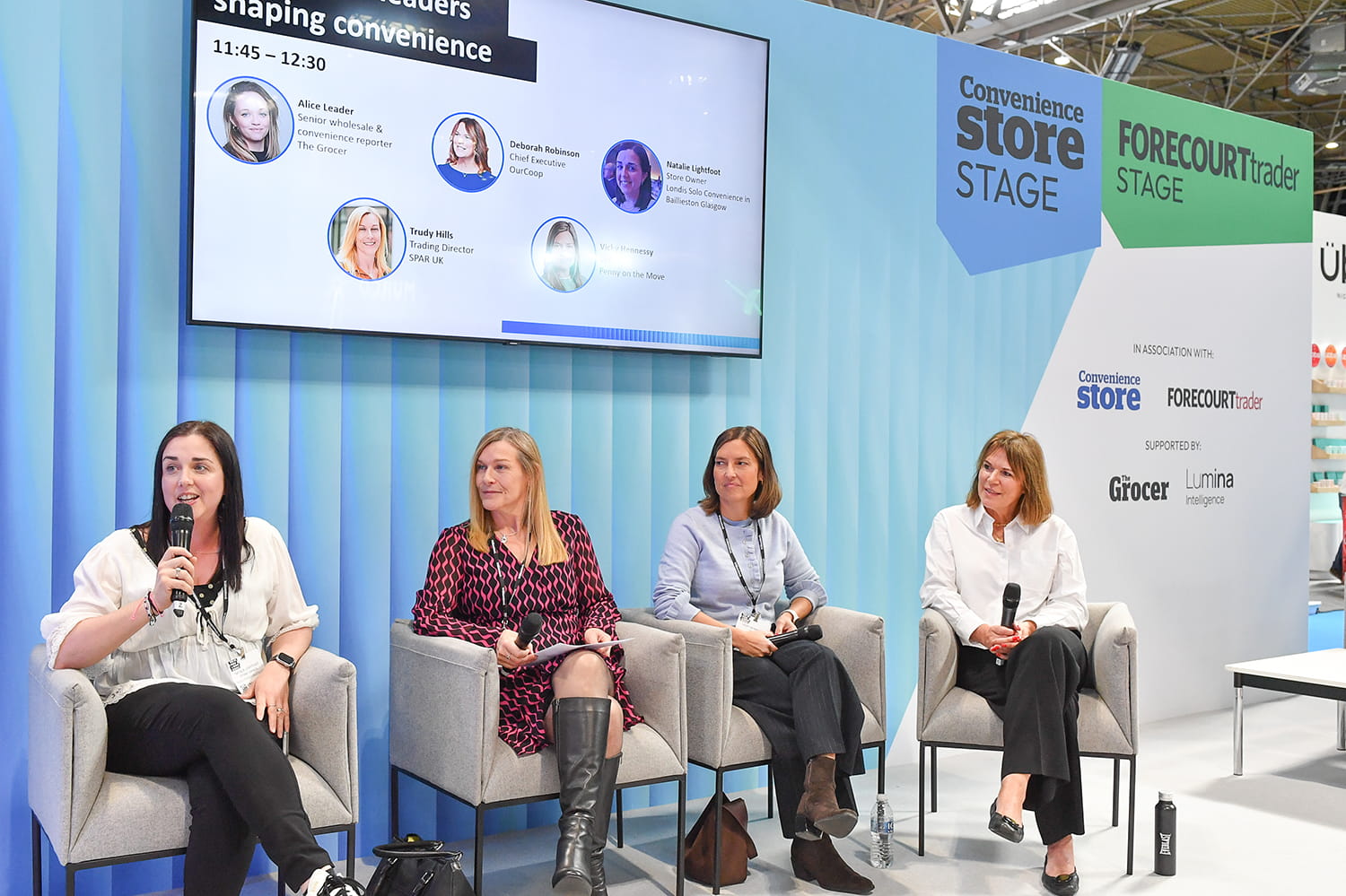
Women make up 69 per cent of the UK convenience workforce but only 37 per cent of those who own or run stores. Leaders from independent retail, SPAR, OurCoop, Booker and Pip & Nut agree the barriers are practical rather than about ability, and so are the fixes: peer networks, sponsors before a career break, flexible and equal parental policies, and published targets.
Based on two sessions delivered at the National Convenience Show and Food & Drink Expo, part of The UK Food & Drink Shows 2026.
Speakers
- Natalie Lightfoot, store owner, Londis Solo Convenience, Baillieston, Glasgow
- Trudy Hills, trading director, SPAR UK
- Vicky Hennessy, chief executive officer, Penny on the Move
- Deborah Robinson, chief executive, OurCoop
- Pip Murray, founder and CEO, Pip & Nut
- Niamh McCormack, independent wellness trends and innovation consultant and co-founder, AEVUM
- Sheila Gallagher, chief commercial officer, Booker
Hosts and moderators, not quoted as opinion-speakers: Alice Leader, Senior Wholesale and Convenience Reporter, The Grocer. Jacqui Parr, Editor, The Grocer.
Estimated read time: 14 minutes
Quick read summary
- Women make up 69 per cent of the UK convenience workforce but only 37 per cent of those who own or run stores, according to the ACS Local Shop Report 2025.
- The barriers the panels described are practical, not about ability: everyday bias, a parenthood penalty, round-the-clock hours and, in convenience, violent crime.
- Progress is real and measurable, from SPAR's commercial team to the shelf, but wholesale still lags retail.
- What works is equally practical: peer networks, sponsors before a career break, flexible and equal parental policies, and published targets.
- For every leader in the room, the message was the same. Spot talent, raise it up and be visible, because other women are watching.
The rep walks through the door, sees the fascia above it and asks the woman behind the till whether the boss is in. For Natalie Lightfoot, Store Owner at Londis Solo Convenience in Baillieston, Glasgow, that question arrived on day one and has never really stopped.
"they would just simply ask, is the boss in? It would never be you."
Natalie Lightfoot, Londis Solo Convenience
That moment captures the gap two panels on women in convenience and grocery set out to examine at the UK Food & Drink Shows 2026. Women already make up much of the UK convenience and grocery workforce. Far fewer own it, lead it or sit where its decisions are made. Seven leaders from independent retail, symbol groups, co-operatives, wholesale and brands explained why, and what closes the gap.
How far have women in convenience and grocery actually come?
Further than the ownership figures suggest, the panels agreed, but not far enough. Vicky Hennessy, Chief Executive Officer of Penny on the Move, pointed to ACS research on the imbalance between who works in convenience and who owns it. The ACS Local Shop Report 2025 puts it plainly: 69 per cent of the convenience workforce is female, yet women account for 37 per cent of those who own or run stores.
In senior commercial teams, change is visible. Trudy Hills, Trading Director at SPAR UK, described the shift in her own business.
"when I joined, there were six commercial directors across the group. They were all men. Now three of them are women."
Trudy Hills, SPAR UK
Sheila Gallagher, Chief Commercial Officer at Booker, dated the wider change to measurement. Since around 2017, when UK businesses began reporting gender data, the debate has had numbers behind it, and that has made proactive change possible. Flexible working, entrenched after COVID, has helped many colleagues, men and women alike.
Wholesale is the exception. Gallagher, who joined Booker from the wider Tesco group four years ago, did not soften it.
"Wholesale, when I joined four years ago, was a bit of a surprise because where Tesco and Grocery had shifted forward, wholesale is behind that. It's still very male dominated."
Sheila Gallagher, Booker
On the shelf, progress is easier to see. Niamh McCormack, Independent Wellness Trends and Innovation Consultant and Co-founder of AEVUM, argued that female founders who proved demand in direct-to-consumer and niche retail are now being amplified by the grocers. Her test was simple: "the biggest indicator is always shelf space, ultimately, isn't it?" Pip Murray, Founder and CEO of Pip & Nut, pointed to the Buy Women Built movement, which the show's own coverage puts at more than 2,000 brands.
In independent convenience, the shift is generational. Lightfoot said family retailers approaching retirement are no longer looking only to their sons when deciding who gets the keys, but to daughters, nieces and sisters too.
What does everyday bias look like, from the shop floor to the boardroom?
For Lightfoot, it is the rep who talks over her to a male colleague. It is also the question that has followed her into every shift since she began running the store with her husband, Martin.
"Martin has never been asked that question because it's automatically assumed that it will be me that will be looking after the kids."
Natalie Lightfoot, Londis Solo Convenience
Hennessy described the same pattern at trade events, where visitors routinely address a male colleague rather than her, and she has to pull herself back into the conversation. "We have these things every day," she said, "and I suppose as women, unfortunately, we get used to it".
In boardrooms and investor meetings the bias is subtler. Murray described how female founders tend to be questioned about the risk in their business, while male counterparts are asked about opportunity and growth. McCormack added that unspoken assumptions about a woman's career path, from parental leave to health, quietly raise the perceived risk of appointing her.
Deborah Robinson, Chief Executive of OurCoop, offered a way to turn that against itself. Know your facts, check them twice and let the underestimation work in your favour.
"never underestimate the power of underestimation."
Deborah Robinson, OurCoop
Everyday bias is not a question of ability. It is a question of who gets asked, who gets addressed and who gets assumed to be minding the children.
Why does parenthood still cost women their careers?
This was the panels' sharpest point of agreement. Hennessy dropped to part-time work after having her son and felt every opportunity disappear.
"now I'd say I'm about six years behind my counterpart males because of that sabbatical, if you like."
Vicky Hennessy, Penny on the Move
Gallagher's advice to women preparing for maternity leave is to build sponsorship first. Legal rights matter, she said, but so do the advocates who keep you connected while you are away and argue for the right role when you return. When confidence dips on the way back in, she has a line she uses often.
"Don't forget, you're having a baby, not a lobotomy."
Sheila Gallagher, Booker
The structural fixes, the panellists argued, sit with employers. Hills said the sector is "miles behind other countries" and "miles behind other sectors" on flexible working for people with childcare or caring responsibilities. Murray called for equal parental leave, arguing that matching enhanced leave for fathers is expensive but does "a huge job in… levelling the playing field", and removes the unspoken question of whether a woman is about to go on maternity leave. She was equally blunt about return to office mandates.
"when I see people talking about going back to the office for five days, I actually put my head in my hands"
Pip Murray, Pip & Nut
Midlife is the other pinch point. Asked why women in their forties drop out of leadership, Gallagher pointed to perimenopause and the need for far more recognition of menopause at work, and for more research. She also noted how far the conversation has moved: "you can actually say the word menopause and you don't get a massive gasp in the audience. So that's progress".
Flexible working and equal parental leave are not perks. For women in convenience and grocery, they decide who is still in the room at senior level.
How do leaders run a 24/7 business without burning out?
Nobody on the convenience panel claimed to have solved it. Lightfoot said there is "no clear cut way" to balance home and work, only the habit of checking in with yourself and trying again. Hennessy was candid that work-life balance has "never actually been one of my strengths". She recalled her five-year-old son telling her at bedtime, after a day of work, traffic and swimming lessons, that he had not had any tea.
Hills has settled on a compromise after trying both extremes on holiday.
"I tried that once and fell out with my family."
Trudy Hills, SPAR UK
Her answer now is what she calls permission hours: a short, scheduled window to check emails and make sure nothing is falling over, then a genuine switch-off for the rest of the day. Robinson's advice was to stop trying to be good at everything and hone your superpower instead, because "the things that you're rubbish at, you'll only ever become average at".
What does inclusive leadership look like for women in leadership?
Not the version on television. McCormack said Alan Sugar has become the default picture of a boss in the UK, and that his autocratic, domineering style was for years a blocker to her own ambitions.
"I feel like that's the cultural shorthand for a boss, isn't it?"
Niamh McCormack, AEVUM
Murray, who describes herself as more introvert than extrovert, said the quieter leader has advantages of her own: "You're often the best listener." Her defence is to know her subject better than the loudest voice in the room, echoing Robinson's advice.
"stop apologising for things, stop asking for permission, and stop being such a good girl all the time."
Pip Murray, Pip & Nut
Resilience, McCormack argued, is not something you either have or lack. After a sudden hospitalisation in 2024 changed how she thought about risk, she concluded that "resilience is not necessarily a personality trait. It's actually a learned skill." Hills added a reminder for anyone newly promoted: "the people that put you in that role believe you can do it", so you need the same belief in yourself.
Why is retail crime a leadership issue for women in convenience?
This was the convenience panel's hardest conversation, and one the grocery panel did not cover. Lightfoot described chasing two men who stole beer from her store while she was seven months pregnant, only for one of them, a violent man just out of prison on parole, to threaten to kill her. In a separate break-in she lost about £35,000 of stock, her insurance did not pay out and she had to rebuild with her family's help.
"when you are a female retailer in this industry, there's a lot more that can go wrong."
Natalie Lightfoot, Londis Solo Convenience
Hennessy was held up at gunpoint at 23, while covering a night shift as a manager at B&Q, and said one Penny store had suffered two knife-point robberies in the three weeks before the show. Her concern is the direction of travel.
"I think now the petty crime's getting worse, and there does not seem to be the same consequence."
Vicky Hennessy, Penny on the Move
Robinson was clear about priorities: "Everybody has the right to go to work and return home safely." OurCoop tells colleagues not to intervene, and she called on suppliers to help through how and where stock is merchandised, and on society to stop treating stolen goods as normal. She also criticised the £200 threshold for lower-value shoplifting. The Crime and Policing Act 2026, which received royal assent on 29 April 2026, legislates to remove it, though Full Fact reported the provision was not yet in force in July 2026.
What actually moves the dial for women in convenience and grocery?
Networks came first. Lightfoot spent her first ten years in "fight or flight", treating every other store owner as competition. Joining Women in Convenience, where she is now an ambassador, changed that. She also founded Retail Family, a retailers-only Zoom call every Monday at 7pm for peer support.
"Once I found all the other retailers, male and female, that's when my sales started to soar."
Natalie Lightfoot, Londis Solo Convenience
Gallagher's version of the same idea was to "find your cheerleaders": the peer who points out an idea was yours first, the boss who sponsors your career, the trusted colleague who lets you get things off your chest. She sponsors Booker's gender equality network and works with a women leaders group through the Federation of Wholesale Distributors (FWD) to take that change industry-wide. The aim, she said, is to shift culture rather than settle for tokenism.
Second, inclusion over representation. McCormack drew a clear line.
"representation is not genuine inclusion."
Niamh McCormack, AEVUM
Her test for any initiative was whether you would still make the decision if there were no award to win and no campaign to launch. Hills and Gallagher widened the point beyond gender, to background and personality type. "Some of the quietest people have got the best ideas," said Gallagher, but leaders have to help them speak up, or they end up with groupthink.
Third, commit in public. Asked for one uncomfortable change companies should make tomorrow, Gallagher named published leadership diversity targets, because nailing your colours to the mast pushes the agenda faster.
Finally, leaders have to go looking for talent. Robinson said she had already met a dozen people on the show floor she would give a store to that day.
"And as leaders, we cast a very long shadow."
Deborah Robinson, OurCoop
The commercial case was not in doubt. Murray, who sits on the board of B Lab UK, pointed to UK B Corps, the world's largest B Corp community. B Lab UK figures show UK SME B Corps grew turnover by 20 per cent between 2024 and 2025, almost seven times the 3 per cent for all UK SMEs. A balance of voices, she said, "is actually good business".
Why does visibility matter for women in convenience?
Because people are watching. Murray drew her early confidence from watching another founder build Proper, summed up in the phrase "you can't be what you can't see". Hennessy, who does not enjoy public speaking, does it anyway, and had received many messages from female colleagues that morning.
"I've gone from being a till operator. I've done every single job that there is, and I'm now CEO."
Vicky Hennessy, Penny on the Move
Lightfoot hopes other women look at her and conclude that if she can do it, so can they. Robinson reminded her that "There is no such thing as an ordinary shopkeeper."
The two sessions were also linked in a way nobody had planned. Asked about women-led suppliers, Hills picked out the founder of Pip & Nut, saying it was her personality and the business she had built, rather than the fact she is a woman, that made it work. Murray was speaking on the grocery stage at the same show.
What this means for convenience and grocery businesses
Independent convenience and forecourt retailers: join a peer network before you need one. Plan colleague safety around non-intervention and record every incident. Even a single store can offer flexible shift patterns and talk to staff about their plans before parental leave.
Symbol groups and wholesalers: audit who sits on commercial and trading teams. Put flexible working into field and store roles, not only head office.
Grocery and wholesale buyers: look beyond the pitch deck. Supplier and buyer co-mentoring, such as the programme Murray joined with a Tesco buyer, builds knowledge neither side gets across a negotiating table.
Brand owners and founders: negotiate salaries and valuations properly, and signpost female-founded status where buyers and shoppers can see it.
Larger employers: publish leadership diversity targets, sponsor women before parental leave rather than after, and treat menopause support as a retention issue.
FAQ
How many women work in UK convenience retail?
Women make up 69 per cent of the UK convenience workforce, according to the ACS Local Shop Report 2025. Yet women account for only 37 per cent of those who own or run convenience stores.
What are the biggest barriers facing women in convenience?
Panellists named everyday bias from reps and customers, the career cost of part-time work and parenthood, and the demands of a business that never switches off. Retail crime was raised as a particular risk for retailers, including those who are pregnant. None of these barriers is about ability.
What support networks exist for women in convenience?
Women in Convenience, run by Newtrade Media, connects women in independent convenience across the UK and Ireland. Retail Family runs a weekly Zoom call for retailers. Larger businesses such as Booker run internal gender equality networks.
How can businesses improve gender balance in leadership?
The panellists recommended publishing leadership diversity targets, offering flexible working and more equal parental leave, and sponsoring women before a career break. They also stressed inclusion over representation, meaning diverse voices shape strategy from the start rather than being added afterwards.
Is the £200 shoplifting threshold still in place?
The Crime and Policing Act 2026 received royal assent on 29 April 2026 and legislates to remove the threshold that treats shoplifting under £200 as a summary offence. According to Full Fact, that provision had not come into force as of July 2026.
Conclusion
The two panels came from different corners of the trade, but reached the same verdict. Women in convenience and grocery are not held back by a lack of talent. They are held back by hours, habits, policies and a shortage of people in the room who look like them. Every one of those can be changed by the leaders who already made it through. As Robinson put it, "I feel duty bound to make the path as smooth as we possibly can for those that are coming behind us".
The UK Food & Drink Shows return to the NEC Birmingham from 12 to 14 April 2027. Register Interest now to hear the next conversations shaping the trade, and read the show's earlier insights from women shaping convenience retail.
Author and speakers
- Natalie Lightfoot, Store Owner, Londis Solo Convenience, Baillieston, Glasgow. A first-generation retailer for 19 years, Lightfoot is a Women in Convenience ambassador and founder of Retail Family, a not-for-profit peer support group for retailers. She won the Scottish Grocer Industry Achievement Award.
- Trudy Hills, Trading Director, SPAR UK. An engineering graduate who began her career at Procter & Gamble, Hills previously ran health, beauty and baby at ASDA.
- Vicky Hennessy, Chief Executive Officer, Penny on the Move. Hennessy has been with Penny Petroleum for 12 years and has worked her way up from till operator to CEO over her career. She recently spoke at Harvard University on bootstrapped businesses.
- Deborah Robinson, Chief Executive, OurCoop. Robinson leads the society formed from the merger of Central Co-op and Midcounties Co-operative, having started at Co-op Group, where she helped build its brand management function in the 1980s.
- Pip Murray, Founder and CEO, Pip & Nut. Murray founded the nut butter brand in 2015 and sits on the board of B Lab UK.
- Niamh McCormack, Independent Wellness Trends and Innovation Consultant and Co-founder, AEVUM. McCormack spent most of her career in buying, including nearly four years at Holland & Barrett, where she drove trends and innovation.
- Sheila Gallagher, Chief Commercial Officer, Booker. Gallagher has worked across the Tesco group for more than 25 years and sponsors Booker's gender equality network.
Hosts: Alice Leader, Senior Wholesale and Convenience Reporter, The Grocer. Jacqui Parr, Editor, The Grocer.



